

Fighting for Dogs, Kids, and Peace

Hey folks. Here’s a message from my team on my work this week. Enjoy the weekend. – MRW
Greetings from the Warner press office. Sen. Warner returned to the Senate this week following the heartbreaking passing of his daughter, Madison, and was deeply touched by all who reached out to express their condolences. You can read more about his reflections on her life and his return to work here.
While navigating this loss, Sen. Warner continued pressing for a better Virginia in Madison’s name. He voted to rein in the war in Iran, celebrated the end of the DHS shutdown and the advancement of his legislation to protect kids from predatory AI, and reintroduced legislation to support animal welfare.
Without further ado, let’s get into it.
IRAN UPDATES
This week, the war in Iran passed a troubling milestone – it’s officially been raging for two months. Let’s take stock of where we are – 13 servicemembers have died, hundreds more are injured, the Strait of Hormuz remains effectively closed, and gas prices have surged to $4.39 per gallon nationally.
Sen. Warner has been speaking out consistently against this war, and calling attention to the ways – from tax dollars spent to higher gas prices – that Americans are footing the bill.
Here he is covering where we are:

And here he is explaining the economic costs of this conflict:
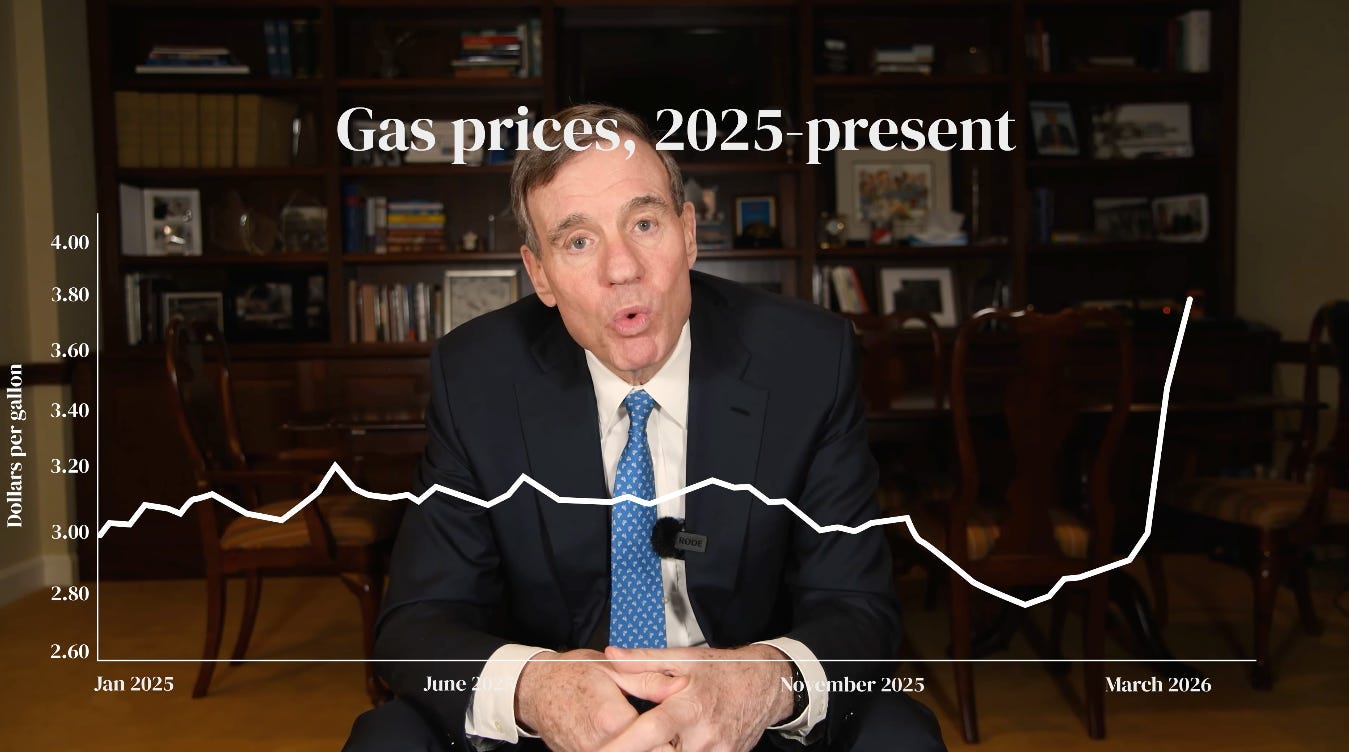
This week, he continued to vote to rein in Trump’s powers and end the war, though Republicans again mustered enough votes to block it.
Afterwards, he said,
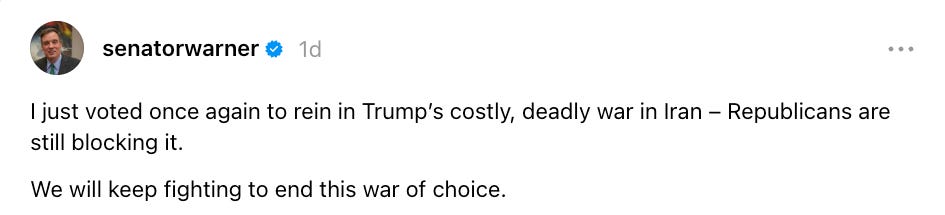
Until this conflict comes to an end, Sen. Warner will keep pressing to hold votes that would stop President Trump’s costly military strikes in the Middle East. We will keep you updated.
R-AI-SING KIDS RIGHT
Imagine you give your kids a teddy bear and it starts talking to them about BDSM sex and where to find knives. Sound far-fetched? Tragically it’s not – it’s a real problem.
While the rapid rollout of AI impacts many aspects of our lives, kids are uniquely vulnerable to certain predatory applications.
AI-enabled companion toys and poorly regulated chatbots are targeting kids and sharing inappropriate information, including promoting suicide and sexual abuse.
Parents shouldn’t have to worry about this deeply alarming threat, so Sen. Warner took action and introduced bipartisan legislation to stop it.
The GUARD Act would ban AI companies from providing AI companions to minors, mandate that AI companions disclose their non-human status and lack of professional credentials for all users, and create new crimes for companies which knowingly make available to minors AI companions that solicit or produce sexual content.
And this week we have some great news… this bill advanced out of committee on a bipartisan basis!
After committee passage, Sen. Warner said:
“AI chatbots put the mental and physical health of young people at risk. I’m encouraged to see this bipartisan legislation advance through committee. It is time to put clear guardrails in place to protect children from manipulative or dangerous chatbot interactions and hold tech companies accountable.”
We’re one step closer to protecting kids from these awful chatbots predatory “companions,” and Sen. Warner will keep pushing until we get it signed into law!
PROTECTING PUPPIES
Let’s end on another uplifting note… Sen. Warner is continuing to fight for puppies across the Commonwealth and country! As an animal lover, Sen. Warner has worked for years on priorities like ending horse soring. He also successfully freed thousands of beagles from an abusive facility in Cumberland, Virginia.
But since he’s not one to rest on his laurels, Sen. Warner once again reintroduced the Puppy Protection Act, legislation that would create stronger standards for veterinary care, housing, and breeding for dogs.
More specifically, this bill would:
Expand enclosure requirements to allow dogs to stand on their hind legs without touching the top of their enclosure and increase the number of square feet of their enclosure based on the dog’s size. Enclosures may not be stacked on top of one another.
Offer dogs over the age of 12 weeks unrestricted access from their primary enclosures to a ground-level, enclosed outdoor exercise area.
Set a 30-minute requirement per day for dogs to socialize with humans and compatible dogs outside of the time spent in veterinary care.
Require a screening by a veterinarian prior to each attempt to breed and prohibit breeding of two litters in any 18-month period or more than six litters in a dog’s lifetime.
After introduction, Sen. Warner said,
“For many of us, dogs are a part of our families. They should be raised in safe and humane conditions throughout their lives. As an animal lover, I’m proud to support this legislation that helps ensure breeding facilities are treating their puppies with respect and care.”
From our kids to our pups, Sen. Warner is fighting for every Virginian.
GRAB BAG
HEALTHY COMMUNITIES: Sen. Warner introduced the Clinical Trial Modernization Act, legislation designed to remove barriers to clinical trial participation and expand access for historically underrepresented communities.
PROMOTING TRANSPARENCY: Sen. Warner introduced the Workforce Transparency Act, legislation that establishes a federal framework to collect timely data to guide policymakers in developing evidence-based solutions to AI’s impact on the U.S. workforce.
PORTS-MONEYYYY: Sen. Warner celebrated more than $16 million in Department of Transportation funding for the Portsmouth Port and Industrial Commission’s agricultural export facility to add storage silos, advanced conveyance systems, and improved rail access.
STANDING WITH SENIORS: Sen. Warner reintroduced bipartisan legislation to protect seniors by empowering nursing homes to better screen and vet potential employees.
PERFORMING TRIA-GE: Sen. Warner introduced the bipartisan Terrorism Risk Insurance Program Reauthorization Act, a seven year extension of a program essential to the country’s economic security by safeguarding the availability of terrorism risk coverage.
THE WEEK AHEAD
The Senate will be in recess next week, resuming on Monday, May 11.
###
And what about the nuclear weapon Iran assured us they almost had ready and were threatening to use. What is the value of eliminating that? Would you have also resisted WWII rationing? How much are we willing to endure to protect our children from a nuclear with a clear stated intent to destroy us?
Sorry to hear of your daughter. I am attending two funerals this week. The end of those relationships if sad.... how much more so for a father to lose a daughter.
https://substack.com/home/post/p-197763836
Important reading. “I want to say one thing about Dario Amodei. Mr. Amodei is the CEO of Anthropic, the company whose product I am using to do what I am doing. He has been, of all the AI executives, the most honest about what is about to happen. He said publicly, in an interview with Axios in 2025, that AI may eliminate half of all entry-level white-collar jobs within five years. He said it because it is true, and he said it because he is one of the few people in his industry willing to say it out loud.
Every time you read an essay on AI and labor, somebody reaches for the Industrial Revolution. The argument is reassuring and it is wrong.
The Industrial Revolution displaced muscle. It displaced muscle slowly, over the course of three generations. It displaced muscle while creating, in its wake, entirely new categories of work the machines could not do—clerical work, professional services, knowledge work, the entire white-collar economy that emerged in the late nineteenth and early twentieth centuries. A loom replaced a weaver, but a loom did not replace an accountant. The machinery could spin thread. It could not write a contract. It could not diagnose a patient. It could not teach a class. The displacement was real and the displacement was painful, and the dispossession that the early Industrial Revolution caused fueled the labor movement, the Progressive Era, the trust-busting, the eight-hour day, the weekend, the entire social contract that defined the twentieth century. But the displacement was bounded by the machines’ limitations, and the displaced muscle had somewhere to go.
AI is doing the opposite of all of that. AI displaces judgment. It displaces judgment at the speed of cloud compute. It displaces judgment while producing, in its wake, new categories of work that the machines also do. The whole reassuring nineteenth-century model—machine takes the old job, new job appears, worker retrains for new job, society moves up the ladder—does not apply, because the new job is also doing the model.”